Right triangles with the same angle are scaled copies, so the ratio of any two of their sides depends only on the angle. Name those ratios sine, cosine and tangent, find their exact values at 30°, 45° and 60°, and use them to find missing sides and angles.
Explain why the ratio of two sides of a right triangle depends only on its angle, using scaled copies.
Define the sine, cosine and tangent of an angle between 0° and 90° as ratios of sides, and show that the tangent is the sine divided by the cosine.
Give the exact sine, cosine and tangent of 30°, 45° and 60° from the two special triangles.
Find a missing side from one side and one angle, and a missing angle from two sides with asin, acos or atan.
In review. The maths and code on this page are checked by automated tests on every change, but an independent reader has not signed it off yet. Spot a mistake or a confusing step? Tell us.
The question
The arrow from \({P = (1, 2)}\) to \({Q = (4, 6)}\) climbs 4 for every 3 across, and it is 5 long. At what angle does it climb? A protractor on a drawing says “a little over 50 degrees”. How can a program get the exact angle from the numbers 3, 4 and 5 alone, and why would a smaller or a larger triangle of the same shape give the same answer?
Intuition
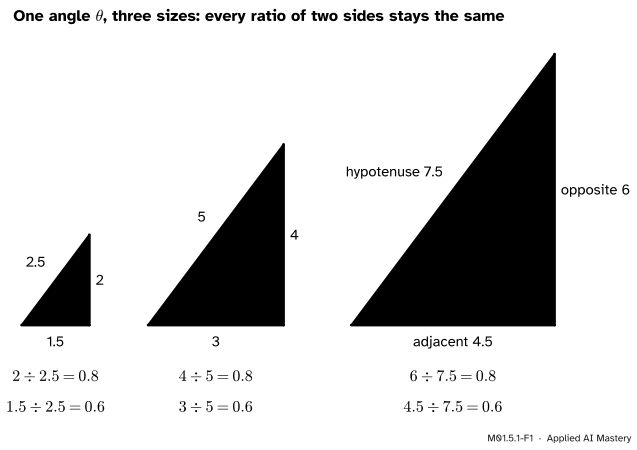
Enlarge a photograph and every length grows by the same factor, while every angle stays as it was. A scaled copy of a triangle is the same idea: multiply all three sides by one number \(k\) and the angles do not move.
Now look at what a scaled copy does to a ratio of two sides. If one side is 4 and another is 5, their ratio is 4 divided by 5, which is \(0.8\). Double the triangle and they become 8 and 10, and the ratio is still \(0.8\). The factor \(k\) multiplies the top and the bottom of the fraction, so it cancels.
M01.5.1-F1
Three right triangles with the same angle \(\theta\). Each is a scaled copy of the others, so the side opposite \(\theta\) divided by the hypotenuse is \(0.8\) in all three, and the side next to \(\theta\) divided by the hypotenuse is \(0.6\) in all three.
In a right triangle, then, the angle decides the shape and the shape decides every ratio of two sides, so each ratio belongs to the angle alone. Throughout this module the side that the sine uses is drawn in vermillion and the side that the cosine uses in sky blue.
Build it up
Step 1. Name the sides from the angle’s point of view. Stand at the corner with the angle \(\theta\), which is between \(0^\circ\) and \(90^\circ\). The hypotenuse is the longest side, the one across from the right angle. The opposite side is the side across from \(\theta\). The adjacent side is the other side that touches \(\theta\), the one that is not the hypotenuse.
Step 2. The same angle forces the same shape. Take two right triangles that both have the angle \(\theta\). Their angles agree: one is \(90^\circ\), one is \(\theta\), and the third is what is left of \(180^\circ\), which is \({90^\circ - \theta}\) in both (the angle sum of a triangle, M01.2.2). Now enlarge the smaller one by the factor \(k\) that makes its adjacent side as long as the larger one’s. Stand the enlarged copy on the larger triangle, corner on corner. The two adjacent sides now match exactly. At one end of that side both triangles have the angle \(\theta\), and at the other end both have a right angle. So the two remaining sides leave the two ends in the same two directions, and they cross at the same point. The enlarged copy covers the larger triangle exactly: every side of the larger triangle is \(k\) times the matching side of the smaller one.
Step 3. A ratio survives the scaling. If the smaller triangle has opposite side \(a\) and hypotenuse \(c\), the larger one has \(ka\) and \(kc\), and
\[
\frac{ka}{kc} \;=\; \frac{a}{c}.
\]
The same cancelling works for any pair of sides. So the ratio of two sides depends only on \(\theta\), never on the size of the triangle.
Step 4. Three ratios get names. There are three ratios worth naming, and the next section defines them. For the arrow from \(P\) to \(Q\), the opposite side is the rise 4, the adjacent side is the run 3 and the hypotenuse is the length 5.
The formal statement
NoteDefinition: sine, cosine and tangent
For an angle \(\theta\) between \(0^\circ\) and \(90^\circ\), take any right triangle with an angle \(\theta\). Then
They are read “sine of theta”, “cosine of theta” and “tangent of theta”. By Step 3, the answer does not depend on which triangle you take.
Each of \(\sin\theta\), \(\cos\theta\) and \(\tan\theta\) is one number, the output of a function whose input is the angle (M01.3.1). Writing \(\sin\theta\) without brackets is a habit of the field; it means \(\sin(\theta)\), not “sin times \(\theta\)”. For the arrow from \(P\) to \(Q\):
The tangent is the sine divided by the cosine. Call the opposite side \(a\), the adjacent side \(b\) and the hypotenuse \(c\). Dividing by a fraction is multiplying by it upside down, and then the hypotenuse cancels:
Check with the numbers: \(0.8\) divided by \(0.6\) is about \(1.3333\), which is \({4/3}\).
Sine and cosine stay between 0 and 1. By Pythagoras (M01.2.2),
\[
c^2 = a^2 + b^2 ,
\]
and \(b\) is longer than 0, so \(c^2\) is more than \(a^2\). Both are positive lengths, so \(c\) is longer than \(a\), and their ratio \(\sin\theta\) is less than 1. The same argument works for the cosine. The tangent has no such limit: a steep triangle has a tiny adjacent side, and \(\tan\theta\) can be as large as you like.
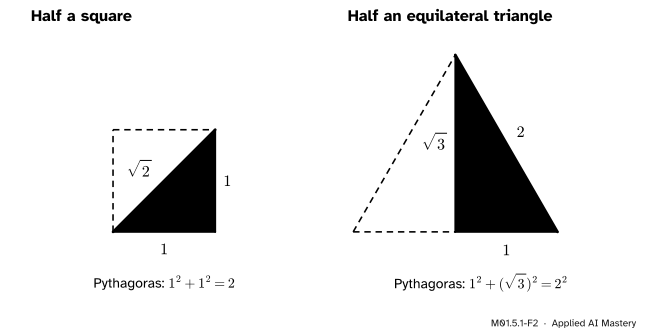
Exact values from the two special triangles. Lesson M01.2.2 built two triangles whose sides are known exactly.
M01.5.1-F2
The two special triangles of M01.2.2. Half a square has angles of \(45^\circ\); half an equilateral triangle has angles of \(30^\circ\) and \(60^\circ\).
In half a square both short sides are 1 and the hypotenuse is \(\sqrt{2}\), so \(\sin 45^\circ\) and \(\cos 45^\circ\) both equal \({1/\sqrt{2}}\). Multiplying top and bottom by \(\sqrt{2}\) gives the tidier \({\sqrt{2}/2}\), about \(0.7071\). The tangent is 1 divided by 1, so \({\tan 45^\circ = 1}\).
In half an equilateral triangle the hypotenuse is 2, the side across from the \(30^\circ\) angle is half the base, 1, and the remaining side is \(\sqrt{3}\). Read each ratio from the corner it belongs to:
\(\theta\)
\(\sin\theta\)
\(\cos\theta\)
\(\tan\theta\)
\(30^\circ\)
\(\tfrac{1}{2}\)
\(\tfrac{\sqrt{3}}{2}\)
\(\tfrac{\sqrt{3}}{3}\)
\(45^\circ\)
\(\tfrac{\sqrt{2}}{2}\)
\(\tfrac{\sqrt{2}}{2}\)
\(1\)
\(60^\circ\)
\(\tfrac{\sqrt{3}}{2}\)
\(\tfrac{1}{2}\)
\(\sqrt{3}\)
As decimals, \({\sqrt{3}/2 \approx 0.8660}\), \({\sqrt{3}/3 \approx 0.5774}\) and \({\sqrt{3} \approx 1.7321}\). Notice that \(\sin 30^\circ\) and \(\cos 60^\circ\) are both \(\tfrac12\): the side across from the \(30^\circ\) corner is the side next to the \(60^\circ\) corner. Exercise 3 shows this pairing for every angle.
Running a ratio backwards. Picture a hypotenuse of length 1 pivoting at the corner. As the angle opens from \(0^\circ\) to \(90^\circ\) its far end climbs steadily, so the sine grows from 0 to 1 and no two angles share a sine. A function in which no two inputs share an output can be run backwards (M01.3.4). Its inverse is written \(\operatorname{asin}\), and many books and calculators write it \({\sin^{-1}}\). In the same way \(\operatorname{acos}\) undoes the cosine and \(\operatorname{atan}\) undoes the tangent. Each takes a ratio and returns the angle between \(0^\circ\) and \(90^\circ\) that has it.
Go deeper: why each inverse needs a limited range of angles
Between \(0^\circ\) and \(90^\circ\) the sine never repeats a value, so its inverse is well defined there. The next lesson extends the sine to every angle, and then it does repeat: \(\sin 30^\circ\) and \(\sin 150^\circ\) are both \(\tfrac12\). So the inverse must pick one answer. By agreement \(\operatorname{asin}\) answers with an angle between \({-90^\circ}\) and \(90^\circ\), and \(\operatorname{acos}\) with one between \(0^\circ\) and \(180^\circ\), and Python’s math.asin and math.acos follow it (in radians, the unit of M01.5.3).
Worked example
Find the angle at which the arrow from \({P = (1, 2)}\) to \({Q = (4, 6)}\) climbs.
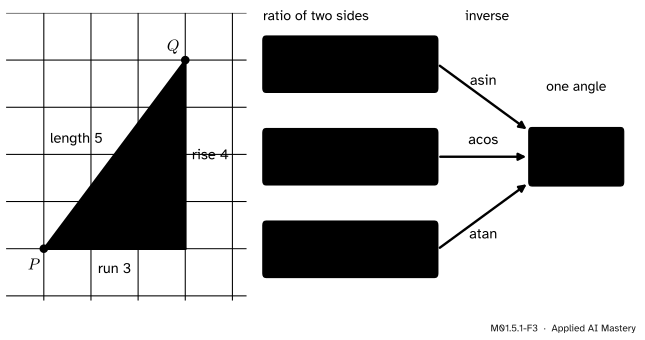
The right triangle under the arrow has run 3, rise 4 and length 5 (M01.2.3). Any one of the three ratios pins down the angle, so work out all three and check that they agree.
M01.5.1-F3
Three ratios of one triangle, three inverse functions, one angle: about \(53.13^\circ\).
From the tangent. The tangent is \({4/3}\), about \(1.3333\), so
From the sine. The sine is \({4/5}\), which is \(0.8\), so \(\operatorname{asin}(0.8)\) gives the angle: again about \(53.13^\circ\).
From the cosine. The cosine is \({3/5}\), which is \(0.6\), and \(\operatorname{acos}(0.6)\) gives about \(53.13^\circ\) once more.
The three routes agree, as they must: they are three views of one triangle. The angle at \(Q\) is the third angle of the triangle, \({90^\circ - 53.13^\circ}\), which is \(36.87^\circ\).
Find a missing side. A ladder 4 metres long leans against a wall and makes an angle of \(60^\circ\) with the ground. How high up the wall does it reach, and how far from the wall is its foot?
Multiply each definition by the hypotenuse and it gives a side: the opposite side is the hypotenuse times \(\sin\theta\), and the adjacent side is the hypotenuse times \(\cos\theta\). Here the ladder is the hypotenuse, the height is opposite the \(60^\circ\) angle, and the distance from the wall is adjacent to it:
First from scratch: the three ratios straight from the side lengths, and a check that a scaled copy gives the same ratios. Nothing here needs more than division.
rise, run =4, 3# the triangle under the arrow from P = (1, 2) to Q = (4, 6)hyp = (rise **2+ run **2) **0.5# Pythagoras: the power 0.5 is the square rootsin_t = rise / hyp # opposite over hypotenusecos_t = run / hyp # adjacent over hypotenusetan_t = rise / run # opposite over adjacentprint("hypotenuse", hyp, " sin", sin_t, " cos", cos_t, " tan", round(tan_t, 4))print("sin / cos =", round(sin_t / cos_t, 4))for k in [0.5, 1, 1.5, 10]: # scaled copies: every side times kprint("k =", k, " opposite / hypotenuse =", round((k * rise) / (k * hyp), 4))
hypotenuse 5.0  sin 0.8  cos 0.6  tan 1.3333
sin / cos = 1.3333
k = 0.5  opposite / hypotenuse = 0.8
k = 1  opposite / hypotenuse = 0.8
k = 1.5  opposite / hypotenuse = 0.8
k = 10  opposite / hypotenuse = 0.8
Python’s math module has the three functions built in, and their inverses. One detail matters: math.sin does not take degrees. It expects a different unit for angles, the radian, which lesson M01.5.3 explains. Until then, pass every angle in degrees through math.radians first, and turn an angle that comes back from math.atan into degrees with math.degrees.
import mathfor angle in [30, 45, 60]: x = math.radians(angle) # degrees to the unit that math.sin expectsprint(angle, round(math.sin(x), 4), round(math.cos(x), 4), round(math.tan(x), 4))print("atan(4/3) =", round(math.degrees(math.atan(4/3)), 2), "degrees")print("asin(0.8) =", round(math.degrees(math.asin(0.8)), 2), "degrees")print("acos(0.6) =", round(math.degrees(math.acos(0.6)), 2), "degrees")ladder =4print("height", round(ladder * math.sin(math.radians(60)), 4)," distance", round(ladder * math.cos(math.radians(60)), 4))
The values match the table and the worked example. The cell rounds before printing because a float is an approximation (M01.1.1). The cosine returns in machine learning as cosine similarity (M02.3.3), which scores how closely two lists of numbers point the same way, from the word counts of two documents to the embeddings of a language model.
Explore
This module’s interactive, the unit-circle explorer, lives in the next lesson. There the hypotenuse is fixed at length 1, so the two shorter sides are the cosine and the sine, and you can turn the angle past \(90^\circ\).
Pitfalls
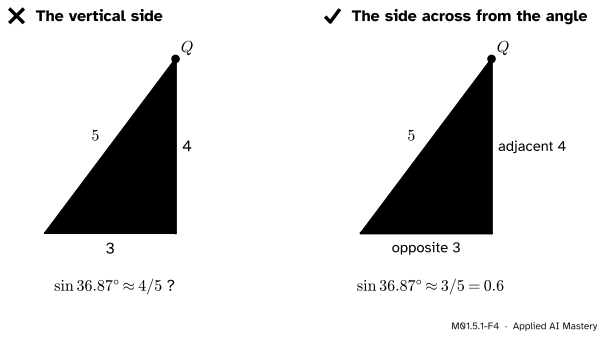
M01.5.1-F4
Wrong beside right. For the angle at \(Q\), the side across from it is the bottom side, 3, not the vertical side, 4.
“The opposite side is the vertical one.”
Opposite means across from the angle you are using, and that changes when you change corners. In the 3-4-5 triangle, the angle at \(Q\) is about \(36.87^\circ\). Across from it lies the bottom side, 3, so its sine is \({3/5}\), which is \(0.6\). Using the vertical side gives \({4/5}\), which is \(0.8\): the sine of the other angle, about \(53.13^\circ\). Before writing a ratio, put a finger on the angle and name the sides from there.
“\({\sin^{-1} x}\) means \({1 / \sin x}\).”
The notation \({\sin^{-1}}\) means the inverse function, the angle whose sine is \(x\), just as \({f^{-1}}\) in M01.3.4 means the inverse of \(f\). So \({\sin^{-1} 0.8}\) is the angle \(\theta\) of the 3-4-5 triangle, about \(53.13^\circ\). The reciprocal \({1 / \sin\theta}\) is 1 divided by \(0.8\), which is \(1.25\): a ratio of two sides, not an angle at all. Writing \(\operatorname{asin}\), as Python does, avoids the confusion.
“Sine is opposite over hypotenuse in any triangle.”
The three ratios need a right angle, because the hypotenuse is defined as the side across from the right angle. In a triangle with no right angle there is no hypotenuse, and “opposite over hypotenuse” means nothing. For such triangles, lesson M01.5.4 derives the law of cosines.
Check yourself
Recall
1. Why do two right triangles with the same angle \(\theta\) have the same ratio of opposite side to hypotenuse?
Show answer
They are scaled copies: all three angles agree, and enlarging one to match the other multiplies every side by the same factor \(k\), which cancels in the ratio.
2. Define \(\sin\theta\), \(\cos\theta\) and \(\tan\theta\) for an angle of a right triangle.
Show answer
\(\sin\theta\) is the opposite side over the hypotenuse, \(\cos\theta\) the adjacent side over the hypotenuse, and \(\tan\theta\) the opposite side over the adjacent side. The last one is also \(\sin\theta\) divided by \(\cos\theta\).
3. What are \(\sin 30^\circ\), \(\cos 45^\circ\) and \(\tan 60^\circ\) exactly?
Show answer
\(\tfrac12\), then \(\tfrac{\sqrt{2}}{2}\) (about \(0.7071\)), then \(\sqrt{3}\) (about \(1.7321\)).
4. Why is \(\sin\theta\) less than 1 for every angle between \(0^\circ\) and \(90^\circ\)?
Show answer
The hypotenuse is the longest side of a right triangle (by Pythagoras its square is the sum of the other two squares), so the opposite side divided by it is less than 1.
5. What does \({\operatorname{atan}(4/3)}\) return in degrees, and what does that number mean?
Show answer
About \(53.13^\circ\): the angle whose tangent is \({4/3}\), the angle at which the arrow from \({(1, 2)}\) to \({(4, 6)}\) climbs.
Exercises
1.★ A right triangle has short sides 5 and 12. Find its hypotenuse, then the sine, cosine and tangent of the angle opposite the side 5, and that angle in degrees.
Show solution
The hypotenuse is
\[
\sqrt{5^2 + 12^2} = \sqrt{169} = 13 .
\]
For the angle \(\theta\) across from the side 5, the opposite side is 5 and the adjacent side is 12:
The angle is \({\operatorname{atan}(5/12)}\), about \(22.62^\circ\), and \({\operatorname{asin}(5/13)}\) gives the same.
2.★★ A kite string 50 metres long is pulled straight and makes an angle of \(30^\circ\) with the ground. How high is the kite above the hand that holds the string, and how far away is it along the ground? Give exact values and decimals.
Show solution
The string is the hypotenuse. The height is opposite the \(30^\circ\) angle and the distance along the ground is adjacent to it:
3.★★★ Show that for every angle \(\theta\) between \(0^\circ\) and \(90^\circ\) the sine of \(\theta\) is the cosine of \({90^\circ - \theta}\), and that the tangents of \(\theta\) and of \({90^\circ - \theta}\) multiply to 1.
Show solution
Take a right triangle with the angle \(\theta\), opposite side \(a\), adjacent side \(b\) and hypotenuse \(c\). Its third angle is \({90^\circ - \theta}\), by the angle sum. The side \(a\) lies across from \(\theta\), so it touches the other corner: it is the side adjacent to \({90^\circ - \theta}\). Hence
Check with \(30^\circ\): \(\tan 30^\circ\) is \({\sqrt{3}/3}\) and \(\tan 60^\circ\) is \(\sqrt{3}\), and their product is \({3/3}\), which is 1.
Summary card
In a right triangle, the angle fixes every ratio of two sides.
M01.5.1-F1
Same angle, same ratios.
\({\sin\theta = \dfrac{\text{opposite}}{\text{hypotenuse}}}\) and \({\cos\theta = \dfrac{\text{adjacent}}{\text{hypotenuse}}}\).
\({\tan\theta = \dfrac{\text{opposite}}{\text{adjacent}}}\), which is \(\dfrac{\sin\theta}{\cos\theta}\).
Exact values: \({\sin 30^\circ = \tfrac12}\), \({\sin 45^\circ = \tfrac{\sqrt{2}}{2}}\), \({\sin 60^\circ = \tfrac{\sqrt{3}}{2}}\); the cosine of \(\theta\) is the sine of \({90^\circ - \theta}\).
A missing side is the hypotenuse times a sine or cosine; a missing angle is \(\operatorname{asin}\), \(\operatorname{acos}\) or \(\operatorname{atan}\) of a ratio.
In Python: math.sin(math.radians(30)), and math.degrees(math.atan(4 / 3)) is about \(53.13\).
Sources and next steps
Sources. Each was opened and checked against this lesson on 12 November 2026.
Jay Abramson and others, Algebra and Trigonometry 2e, Section 7.2 Right Triangle Trigonometry, OpenStax. Names the adjacent and opposite sides and the hypotenuse, defines the sine, cosine and tangent as opposite over hypotenuse, adjacent over hypotenuse and opposite over adjacent, gives the sides of the 30-60-90 triangle in the relation \(s\), \(s\sqrt{3}\), \(2s\), and finds the remaining sides from one side and one acute angle.
Jay Abramson and others, Algebra and Trigonometry 2e, Section 8.3 Inverse Trigonometric Functions, OpenStax. The ranges of the inverse sine (\({-\pi/2}\) to \({\pi/2}\)), the inverse cosine (\(0\) to \(\pi\)) and the inverse tangent, and the warning that \({\sin^{-1} x}\) does not mean \({1/\sin x}\).
Python Software Foundation, math — Mathematical functions, Python 3.12 documentation, sections “Trigonometric functions” and “Angular conversion”. math.sin, math.cos and math.tan take an angle in radians; math.asin, math.acos and math.atan return one; math.radians and math.degrees convert.